Obsessive-Compulsive Personality Disorder - Outside the DSM



Obsessive-compulsive personality disorder1 has a boring, straightforward history, though it is interesting that it (compulsively) was renamed back and forth between obsessive-compulsive personality disorder and compulsive personality disorder. Importantly, one can have obsessions1 (repetitive unwanted thoughts), compulsions1 (repetitive unwanted behaviors), or both; however, a person with obsessive-compulsive personality disorder may not have either, just the core defenses2 (discussed below). It gets pretty confusing, so let’s start by discussing the differences between symptoms and personality.
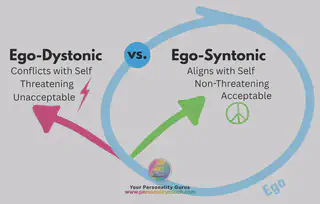
Symptoms vs. Personality in the Obsessive-Compulsive Spectrum
As symptoms, both obsessions and compulsions can happen in any personality. In fact, we often see a strong compulsive component in dysfunctional personalities demonstrated by symptoms, but these are not the core personality. Obsessive and compulsive symptoms are ego-dystonic, meaning they are bothersome and distressing. In contrast, they are ego-syntonic in someone with an obsessive-compulsive personality, meaning they are acceptable 2 3. This can occur within the same person. For example, my compulsion to have an even number of steps before I change direction can be annoying and frustrating to me (ego-dystonic), AND my compulsive tendency to write and rewrite my lists and sticky notes can be perfectly acceptable to me (ego-syntonic). But how does it fit into a personality disorder? For that, we have to look at early childhood…all the way back to potty training 💩 and Freud’s anal developmental stage / anal character.

Freud’s Anal Stage of Development & Obsessive-Compulsive Personality 4 2
The obsessive-compulsive personality has a core (unconscious) conflict involving the fear of being punished versus rage at being controlled. It’s a power conflict (anal-retentive phase) that stems from potty training, which Freud fairly theorized in his psychosexual developmental stages. Even though Freud was not always in his right mind, we have redeemed the anal character that has a fixation at the anal development stage, which involves unconscious difficulties around handling aggressive urges. Specifically, Freud found three main things:
- Both potty training and obsessive-compulsive personality disorder are wrought with issues such as being clean, stubborn, and punctual, as well as a tendency toward withholding.
- He found potty-ing verbiage in the speech, dreams, fantasies, and memories (“anal imagery”) of those with obsessive-compulsive personality disorder. For example, one might emotionally “tighten up,” “keep everything inside,” or procrastinate and not “produce.”2
- Those with obsessive-compulsive personality disorder usually have a history of their parents trying to potty train too early, too harshly, or just in an overinvolved manner.
But what is it about potty training that is such a big deal here that it impacts personality?!

Potty Training & Obsessive-Compulsive Personality 2
Potty training is the first time we have to hide natural processes, like peeing and pooping, in order to be socially acceptable. Previously, an infant is free to potty at their leisure. A 3-month-old’s pooping face is adorable, but a 2-year-old’s pooping face means we’re rushing to the potty and trying to keep it in until we can release it acceptably. This is the potty training power struggle that the child will ultimately lose. So, if the parent is controlling, judgmental, and holds high scheduled expectations, the child can easily develop aggressive fantasies about pooping, but those aggressive urges are usually compartmentalized into a bad/messy/shameful/sadistic part of the self that holds guilt, shame, anxiety, fear, and anger. To handle that “bad” part, the obsessive-compulsive personality learns to control, clean, and reason to maintain identity and self-esteem. This all-or-nothing dynamic mirrors the attempt to suppress all the bad parts of the self, creating a conflict between good and bad in the self, others, the ego, and basically everywhere.
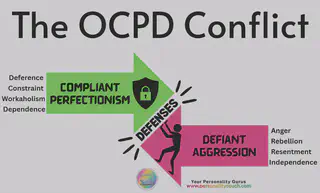
The Conflict of the Obsessive-Compulsive Personality 4 2 3
For the obsessive-compulsive personality, they face a constant internal struggle between defiance and compliance with their deference leading to resentment and anger, and their anger leading to suppressing it by perfectly complying with rules and others’ wishes. They feel they must stay in control, lest their aggressive urges be exposed, so they bury their anger, resentment, and desire to be independent. Millon3 said it best in his quote: “Their restraint, however, is merely a cloak with which they deceive both themselves and others; it serves also as a straightjacket to control intense resentment and anger” (Millon, 2011, p. 481)
How do they handle this conflict? Like all persons, they deploy defense mechanisms.

Common Defense Mechanisms in Obsessive-Compulsive Personality Disorder 4 2
We all use defense mechanisms or ego defenses to handle anxiety, psychological conflicts, and threats to the psyche. It’s how we use them that matters. Are they helpful or unhelpful? Those with obsessive-compulsive personality disorder tend to use the following defenses, though this list is not at all exhaustive.
Reaction Formation involves combating unacceptable impulses by replacing them with opposite, acceptable desires that can then be tolerated and thus conscious. An adaptive example of reaction formation is deferring to and respecting an authority figure, keeping their underlying aggression unconscious. A pathological example of reaction formation might be a mother who (unconsciously) resents her child, but smothers the child in a way that restricts their independence.
Isolation of Affect is when emotions are split off and isolated so that events and cognition can be accessed, but the emotions are inaccessible. Less extreme forms of isolation of affect are rationalization (justifying “bad” emotions), moralization (morally justifying “bad” emotions), compartmentalization (separating emotion and logic), and intellectualization (logic-ing emotions so they don’t fully experience them). An adaptive example of isolation of affect would be a surgeon cutting off their own emotions of anxiety when opening their patients for surgery. A pathological example might be the same surgeon cutting off their own emotions of guilt as a busy father, impairing his ability to connect with his children. Those with obsessive-compulsive personality disorder are great at formal work, but not so great with relationships and intimacy.
Undoing involves behavioral attempts to protect or atone for unacceptable thoughts/emotions by trying to nullify or negate them. A benign or even adaptive example of undoing would be bringing your partner a gift or apologizing the day after a fight (as long as the guilt stays unconscious, this is a defense against the guilt). A pathological example of undoing might be excessive daily cleaning that impairs life in order to handle anxiety about sinful thoughts.

In sum, this is confusing! Every personality can experience symptoms (e.g., obsessions, compulsions) and use defense mechanisms (e.g., isolation, undoing, reaction formation) that those with obsessive-compulsive personalities tend to utilize. It’s hard to parse all this out! If you want to better understand these dynamics in yourself or others, therapy and/or psychological testing can help! If you’re in Virginia (or a PsyPact state), check out Quest Psychological and Counseling Services for available services. If you’re a provider stuck on a case, we also offer consultations for mental health professionals!
References
American Psychiatric Association. (2022). Diagnostic and statistical manual of mental disorders: DSM-5-TR (5th edition, text revision.). https://doi.org/10.1176/appi.books.9780890425787 ↩︎ ↩︎ ↩︎
McWilliams, N. (2011). Psychoanalytic diagnosis: Understanding personality structure in the clinical process (2nd ed.). Guilford Press. ↩︎ ↩︎ ↩︎ ↩︎ ↩︎ ↩︎ ↩︎
Millon, T. (2011). Disorders of personality: Introducing a DSM / ICD spectrum from normal to abnormal (3rd edition). John Wiley & Sons, Inc. ↩︎ ↩︎ ↩︎
Lingiardi, V., & McWilliams, N. (Eds.). (2017). Psychodynamic diagnostic manual: PDM-2 (2nd ed.). The Guilford Press. ↩︎ ↩︎ ↩︎
