Rethinking Antisocial Personality Disorder



Confession: I cracked open a whole bunch of stuff on antisocial personality for this new series, and it feels like my brain imploded. There is SO much information, and a lot of it is conflicting. I boiled down my processing to three main focuses:
- What is involved in the inner workings of the antisocial personality?
- Where is the line where the antisocial personality becomes disordered?
- How do we handle morality within a psychologically based personality disorder?
Inside the Antisocial Personality1 2
Writing a comprehensive understanding of the inner workings of the antisocial personality would take a book, so I will attempt to briefly cover the prominent points. I cannot simply take the DSM-5-TR’s conceptualization of antisocial personality disorder by itself because it doesn’t look at the inner workings of the person but rather focuses on overt, observable behaviors and criminality. Yet, antisocial behavior can be a symptom of many different personality types…Not all criminals are antisocials, and not all antisocials are criminals (duhh🙄). While also not comprehensive, I have anchored my understanding of antisocial personality in the PDM-2 (pp. 50-512) explanation because it doesn’t focus on criminal behavior, noting there are many antisocial personalities that are able to fit into the society (e.g., law, military, police, Wall Street). Key features of the antisocial personality include a possible temperament that is more aggressive with a higher threshold for emotional stimulation (i.e., lower anxiety, higher need for stimulation). They often experience abusive and/or traumatic childhoods3 4, learning to believe “everyone is selfish, manipulative, dishonorable, and/or weak” (p. 512). This results in a fear of being manipulated by others, so they have to manipulate first, which stems from primitive envy and is often expressed through rage. They can become stuck in primary narcissism where they are focused on the self and their own satisfaction, not understanding that others are separate from them. They might think, “I can do whatever I want” (p. 512) to make sure their self-interest is first, which means they must have all the power and control to protect and defend themselves. 💪…But when are these patterns actually considered disordered?
When is an Antisocial Personality Disordered?
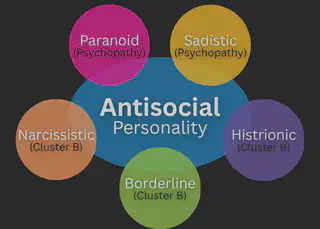
The DSM1 focuses on disorder level being abnormal (hence abnormal psych class), but then what is a normal antisocial personality? 🤯 There has to be distress or negative impacts in life, but for this self-oriented personality3, the distress can fall on others1. “Antisocial personality” inherently implies that these individuals do not fit in the societal box, playing by a different set of rules, yet that doesn’t mean it’s bad or pathological. So, where is the line the antisocial personality crosses to enter into disordered territory? How bad does it have to be? My first idea was that their persistent personality dynamics are harmful to others. Like, killing isn’t okay…except when society deems it “acceptable” in certain situations ranging from killing to protect (e.g., military), ➡️to killing innocents in fear (e.g., salem witch trials), ➡️to genocide (not going to touch that one😔). Thus, the line for disorder territory cannot be harming others because that line changes based on society’s definition. All of this just makes me conclude that we don’t know where the line is, and that the answer should be determined on a case by case basis. Especially because antisocial personalities can overlap with quite a few other personalities…since we obviously have to make this even more complicated. 😵💫 I’ll get into this more in an another blog, but for now, I’ll leave you with this graphic to illustrate the overlap…before jumping into another overlap: psychology and morality.
Morals and Antisocial Personality
When morality and psychology come head to head, there are often intense reactions, emotions, and conflict (e.g., Milgram experiment, Stanford prison experiment, interrogation/torture debates). Morality and psychology cannot fully be separated, and this is relevant to understanding antisocial personalities. All the way back in 1835, a guy named Prichard coined the term moral insanity, which is not the same as our current antisocial personality disorder, but it influenced the construct5 3 4. The part I find super important is that Prichard was apparently a major advocate that these types who were “morally insane” should be socially condemned3 4. There is a problem when we place a moral, value-laden position on a psychologically complex construct. Morally, we condemn antisocials and are quick to ostracize them, yet psychologically, we seek to understand and treat antisocials. It is conflictual.
We need all personality types in society, and that includes antisocials. There are laws that were placed long ago, and some in current practice, that need(ed) to be challenged (e.g., woman couldn’t vote, Blacks couldn’t sit on a bus, women can’t buy a hat without their husband’s permission in Kentucky, you can get fined $500 for sending unsolicited pizza in Louisiana). But on a serious note, we need personalities that push the envelope and do what none of us dare to do (e.g., 💣disposal, Navy Seal) and sometimes set an example that we view as against cultural norms. We need some antisocial personalities to call out society’s bull💩 unapologetically and bulldoze broken systems for repair. We need antisocials to handle crises, negotiations, high-stake litigation; and to jump out of planes to save others. As with all personalities, we need antisocials to better society, not to permanently destroy it. Thus, we do not need pathological antisocial behavior in society. However, because antisocial personalities don’t play by society’s rules, the line seems to be “whatever doesn’t benefit society in the current moment,” which ventures into morality. For example, when Timothy McVeigh killed in military combat, it was acceptable, but when he bombed a building full of people, it was not (See When Paranoid Personalities Kill (Ep. 32) for a detailed analysis of this case). Morally, many would agree that murder in war is acceptable. Psychologically, McVeigh’s pathological motivation to kill was likely present in combat too, making it a disorder…but would we have known this if he hadn’t become the Oklahoma City Bomber? Probably not.
In conclusion: There is no clear line where antisocial personalities become disordered. 🤷

Can Antisocial Personalities be Treated?
Assuming we can adequately understand an antisocial personality at the disorder level, are they treatable through therapy? Unfortunately, most people ask if we should treat them, venturing into morals and values.
This does reflect the inaccurate stereotype that, as a class, antisocials are not treatable5 - a vindictive dynamic in society where “moral judgment impinges on professional assessment” (p. 1673).
Why? Because antisocials write off others’ needs, and so we write off antisocials’ needs, but this ignores severity and individual differences5 4.
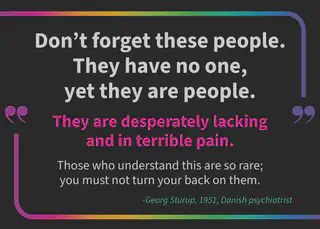
There needs to be a clear understanding that multiple things can exist at the same time. The antisocial personality’s psychological/emotional pain is valid, as is everyone’s pain, AND their harmful/destructive behavior is not acceptable. Treatment with an antisocial personality needs to be incorruptible and extremely boundaried. Empathy is viewed as weakness by the antisocial, so it has no place in the treatment room. Power, however, is the currency that can be used to gain respect5. Thus, it is extremely difficult for therapists to treat antisocial personalities. We’re uncomfortable with our own darkness, and so we automatically throw those labeled antisocial into the “untreatable” bucket 🗑️. I personally find this ridiculous and hypocritical. Additionally, research does show that institutions provide a better chance of successful treatment for antisocials because there is inherent, fortified structure, hierarchy, and boundaries4. So, can antisocial personalities be treated? Yes. Some antisocial personalities can make progress5 4.
Antisocial personality dynamics are convoluted, complex, and sometimes dangerous. If you need support for yourself or an antisocial personality in your life, please reach out. If you’re in Virginia (or a PsyPact state), check out our private practice, Quest Psychological and Counseling Services for available services. If you’re a provider stuck on a case, we also offer consultations for mental health professionals!
References
American Psychiatric Association. (2022). Diagnostic and statistical manual of mental disorders: DSM-5-TR (5th edition, text revision.). https://doi.org/10.1176/appi.books.9780890425787 ↩︎ ↩︎ ↩︎
Lingiardi, V., & McWilliams, N. (Eds.). (2017). Psychodynamic diagnostic manual: PDM-2 (2nd ed.). The Guilford Press. ↩︎
Millon, T. (2011). Disorders of personality: Introducing a DSM / ICD spectrum from normal to abnormal (3rd edition). John Wiley & Sons, Inc. ↩︎ ↩︎ ↩︎ ↩︎
Millon, T., Simonsen, E., Birket-Smith, M., & Davis, R. D. (Eds.). (2003). Psychopathy: Antisocial, criminal, and violent behavior. Guilford Press. ↩︎ ↩︎ ↩︎ ↩︎ ↩︎ ↩︎
McWilliams, N. (2011). Psychoanalytic diagnosis: Understanding personality structure in the clinical process (2nd ed.). Guilford Press. ↩︎ ↩︎ ↩︎ ↩︎ ↩︎
