The Dark Schizoid


I believe schizoid personality disorder is the most misunderstood personality disorder. While theories like psychodynamic have a deeper understanding of the internal turtle-y workings involved in schizoid dynamics, Millon and the DSM-5-TR take a deficit-based approach, highlighting criteria such as a lack of or decreased capacity for emotions, pleasure, intimacy, community, and desire for interpersonal connection1 2. Most schizoid personalities are quite harmless, passively flying under the radar and busying themselves in their minds rather than the world. In contrast, those with antisocial personality disorder are actively going against rules, norms, and the law. Are these two personalities too different to overlap or combine? Let’s explore!
Similarities & Differences Between Schizoid & Antisocial
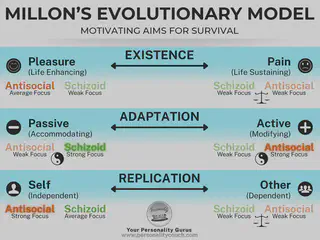
There are no overlaps or cross-mentions of schizoid and antisocial personality disorder in the DSM-5-TR1. Millon’s theory notes they are opposite in terms of adaptation and energy, with schizoids being passive and antisocials being active2. They are both detached from pain, but the schizoid is also detached from pleasure while antisocials can be pleasure seeking2. Antisocials are strongly self-oriented, while schizoids are average in this area; however, both are detached from others2. So the main overlaps here are detachment from others and pain, yet we’re still comparing antisocial tigers to schizoid turtles.
Other similarities include childhood neglect from parents, non-responsiveness, non-conformity, and aloofness…but again, there are different dynamics underlying these. Childhood neglect leads to detachment in both the schizoid and antisocial3, but the schizoid detaches from the world and their own needs, while antisocials detach from anything viewed as “weak” such as emotions, dependent needs, and even empathy. Non-responsiveness to the environment stems from the central nervous system4 with schizoids able to detach from the world and their own bodies, while antisocials have higher thresholds for activity due to childhood trauma. Non-conformity is different as well. For the schizoid, the underlying intent is detachment from the need to conform or please others, not defiance. For the antisocial, there’s an active movement to prove their control and autonomy2. In regard to aloofness5 6, schizoids engage in a solitary lifestyle, showing indifference to relationships, finding intimacy and people-ing too much. Antisocials are aloof in their rejection of others and society. They don’t fit in, they don’t want to fit in, and they do their own thing, making up their own rules to life. So we’re back to the question - can these dynamics overlap within the same person?

Nomadic Antisocial Subtype 2
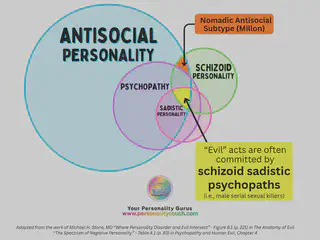
Millon describes a Nomadic Antisocial subtype, which is an antisocial personality that has schizoid features. Because of rejections and injustices experienced in their past, they still harbor deep resentment, anger, and pleasure-seeking tendencies. However, they aren’t as active in their pursuit of revenge, instead detaching from social and societal responsibilities in order to defend against feeling ostracized, abandoned, and doomed. Their main focus is basic survival, as they roam, drift, and wander along the outskirts of society. It’s been suggested that they are unconsciously forever looking for a home. At a severe level, if they are provoked and/or using substances, they may act out impulsively, abuse alcohol, or become a predator.
When Detachment Turns Psychopathic…and Sadistic… 5 6
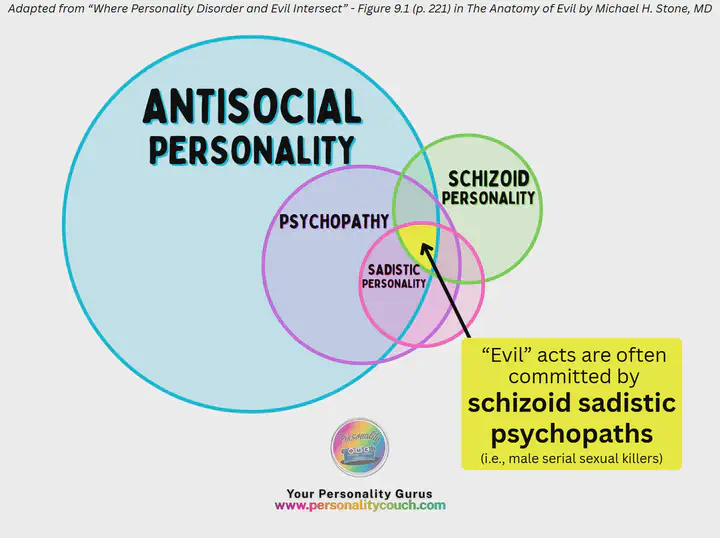
The overlap between schizoid and antisocial includes detachment, non-conformity, and aloofness, and if you travel to the very extreme end of severity, this is where there is danger in psychopathy. Think about it like this: psychopaths detach from people so hard that they view individuals as inanimate objects to manipulate and mutilate. The interesting thing here is that the three personality disorders that are most associated with violent crime include antisocial, psychopathic, and sadistic, BUT add in a flavor of schizoid aloofness and detachment, and we find a group containing about 50% of males who commit serial sexual murder. So not a schizoid personality at the core, but adding in the schizoid flavor to darker personalities increases risk of danger and “evil.” Check out the serial killer Dennis Nilsen as an example.
Enneagram
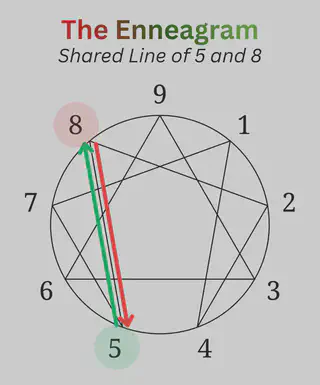
Looking at extremes, darkness, and danger is always fascinating, but it’s very rare. Much more common are healthier overlaps containing schizoid and antisocial dynamics. Because the DSM-5-TR focuses on pathology, there’s not much information on healthy/normative personality dynamics, so I like to use the Enneagram to describe it. Simplistically, there is a shared line of growth and stress between Type 8s (antisocial dynamics) and Type 5s (schizoid dynamics). I’ll have to save an in depth analysis of this for its own blog, but in sum: Schizoid and Antisocial can overlap!
If you want to better understand an antisocial individual in your life, or if you are an antisocial or schizoid personality and want to explore it more, feel free to reach out! If you’re in Virginia (or a PsyPact state), work with us here. If you’re a provider stuck on a case, we also offer consultations for mental health professionals!
References
American Psychiatric Association. (2022). Diagnostic and statistical manual of mental disorders: DSM-5-TR (5th edition, text revision.). https://doi.org/10.1176/appi.books.9780890425787 ↩︎ ↩︎
Millon, T. (2011). Disorders of personality: Introducing a DSM / ICD spectrum from normal to abnormal (3rd edition). John Wiley & Sons, Inc. ↩︎ ↩︎ ↩︎ ↩︎ ↩︎ ↩︎
Putri, A. A. T., Parwatha, N. W., Sutrisna, I. P. B., & Wiguna, I. G. R. P. (2024). Parenting models, spirituality and personality disorders in adolescence: A literature review. International Journal of Health & Medical Sciences, 7(2), 40-52. https://doi.org/10.21744/ijhms.v7n2.2279 ↩︎
Raine, A., & Venable, P. H. (1984). Electrodermal nonresponding, antisocial behavior, and schizoid tendencies in adolescents. Psychophysiology, 21(4), 424-433. https://doi.org/10.1111/j.1469-8986.1984.tb00221.x ↩︎
Stone, M. H. (2007). Violent crimes and their relationship to personality disorders. Personality and Mental Health, 1(2), 138–153. https://doi.org/10.1002/pmh.18 ↩︎ ↩︎
Stone, M. H. (2017). The Anatomy of Evil. Prometheus Books. ↩︎ ↩︎
